

Exit Article button
A label that reads 'Forging home, the migration issue'
Issue 02
Issue 02

Who gets to be seen as 'deserving' of a life in Australia and who is being left behind?  When we create a hierarchy of worth, we don’t just devalue disabled migrants, we silence them. We erase the contributions that don’t show up on tax returns.

words BY IGA MORZYNSKA, images by sejal Bhikha
12 MIN READ
I first learned about Australia as a child when my dad took me to an Aboriginal art exhibition in my hometown of Bydgoszcz, Poland. When we got home, he showed me a book about Australia’s geography that he had read as a child. My dad had always been deeply fascinated by Australia. In fact, when communism ended in Poland in 1989, he filled out an application to relocate to Australia. He completed it but somehow never made it to the post office to submit it. Through my dad’s curiosity and stories, I began to feel drawn to a place I had never seen.

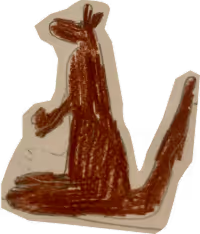
In Grade One, we were asked to draw who we wanted to be when we grew up. Looking back, I’m pretty sure the teacher meant a profession. Most kids in class drew firefighters, doctors and super stars. I drew a kangaroo. Although I had completely misunderstood the assignment, now I’m so glad I did. My mum kept that drawing, along with dozens of other similar drawings I made over the years. Today, I keep that drawing close as a reminder of how deeply I longed to be here.

I imagined Australia as a place impossibly far away, so distant from where I grew up that it became easy to idealise. I turned it into something almost utopian, an imagined destination where I could live my best life and become the happiest, most fulfilled version of myself. The Australian dream, as I saw it – warm climate, the ocean (little did I know I would end up in Canberra of all places), and above all, a deeply progressive country defined by safety, inclusion and respect for human rights. I clung to this idealised vision of a place where I thought I would immediately belong.

I moved to Australia 13 years later at the age of 19 to start university.

The Migration System

I love living here. I worked incredibly hard to make my childhood dream a reality. And although I remain deeply grateful for the chance to build a life here, I can also admit that the emotional cost of staying and the toll it’s taken to hold onto this dream has been far greater than I ever anticipated.

To my disappointment and growing disillusionment with Australia’s image as a country that champions equality, the migration system isn’t built to serve everyone equally.

While migrants might share the same ambition, determination and expectations for their futures, the opportunity to dream and to turn this dream into reality isn’t evenly accessible. Structural barriers within the system mean that having a disability transforms the process that in theory is fair and equal to what’s often an isolating and discouraging struggle.

Australia often prides itself on being a diverse and welcoming nation, but currently, under the Australia’s Migration Act 1958 people with disabilities and their families can be refused visas because they are unable to meet strict health requirements.

Most visa applicants must complete a health check to assess whether a person might pose a health risk, use public services or simply cost the government too much money. Applicants are judged against a ‘Significant Cost Threshold’ (SCT), which assumes they will access government-funded services, regardless of whether they actually will. Currently, this threshold is AUD $86,000. This amount remains shockingly low especially when compared to countries like Canada, where the cost threshold is much higher (approximately AUD $140,300) and considers real-world context.

For example, Canada allows applicants to respond through a procedural fairness process, giving them a chance to explain their circumstances, or show how costs could be reduced rather than relying on assumptions. In 2022, Canada has also changed its rules to remove special education, social and vocational rehabilitation centres and personal support services from cost calculations as a step towards ‘reducing barriers for people with disabilities (…) and promoting inclusion for people who, despite their health condition, can make a contribution to Canada including persons with disabilities’.
     
Although it is open to question how far these commitments translate into practice, they at least reflect a clear recognition that migrants with disabilities are valuable members of society and should not be viewed solely as economic burdens. This is something that still remains largely absent from Australia’s migration system.

However, despite these acknowledgements, even this “improved” system continues to benefit those most privileged, such as migrants with support networks and family members able to provide care and those who can afford private health insurance.


“Placing a monetary limit on access to healthcare... inherently frames people as economic liabilities rather than human beings with equal rights.

Placing a monetary limit on access to healthcare, such as the SCT, inherently frames people as economic liabilities rather than human beings with equal rights. This ableist approach ignores the fact that access to healthcare is widely recognised as a basic human right, and that no one’s value should be measured by the cost of their medical needs.

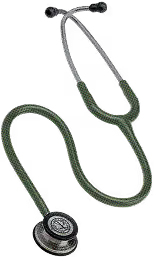
I still remember walking into my first health assessment hoping to be truly seen and recognised as a whole person with goals, passions, plans and dreams for the future. In my head I had rehearsed what I wanted to say: my ambitions after graduating and the life I hoped to build. I wanted them to see me as me, as Iga, not my disabilities. The reality was very different. The appointment lasted no more than fifteen minutes,  most of it spent answering one-sided questions while the Medical Officer silently ticked boxes on a screen.

To make matters worse, Australia’s migration laws are legally allowed to discriminate against people with disabilities. While the Disability Discrimination Act (DDA) protects people with disabilities in areas such as education, employment and access to services, Section 52 of the DDA exempts actions taken under the Migration Act. This means refusing a visa based on disability or health is legal, even though it would otherwise be seen as discriminatory.

The exemption also goes against Australia’s commitments under the United Nations Convention on the Rights of Persons with Disabilities (CRPD), which promises equal rights and protection from discrimination, including in migration. In 2019, the CRPD criticised Australia’s approach, specifically recommending that Australia ‘review and amend its migration laws and policies to ensure that persons with disabilities do not face discrimination in any of the formalities and procedures relating to migration and asylum.

Despite these international recommendations, the Australian government has not taken action to align its migration policies with the CRPD. As a result, the current migration framework represents a significant failure to uphold both national and international commitments to human rights and equality.

The “Perfect Migrant” Myth

The day I went to my mandatory health check, I brought my resume with me. Just in case. Just in case the medical officer would question my capacity to work. I had physical proof of my productivity, full-time work, three university degrees – a track record I hoped would override whatever assumptions might be made about me. Trying to prove that I could meet all the expectations without being much of a burden.

I had spent so much energy trying to prove my worth, to demonstrate that I could meet every expectation placed upon me – knowing that in this system, the value of human life is filtered through the cold logic of productivity. You're welcome here, we need you unless. Unless you’re disabled. Unless you might cost us money.

Australia’s migration system, particularly skilled migration, is built around one defining question: What can you do for us? Can you fill a skills shortage? Can you earn enough money and positively contribute to the economy? Salary thresholds, points-based rankings, and health assessments all focused on what you’ll cost versus what you’ll give.

That’s the unspoken demand of capitalist migration policy: not just to work, but to constantly prove your productivity.

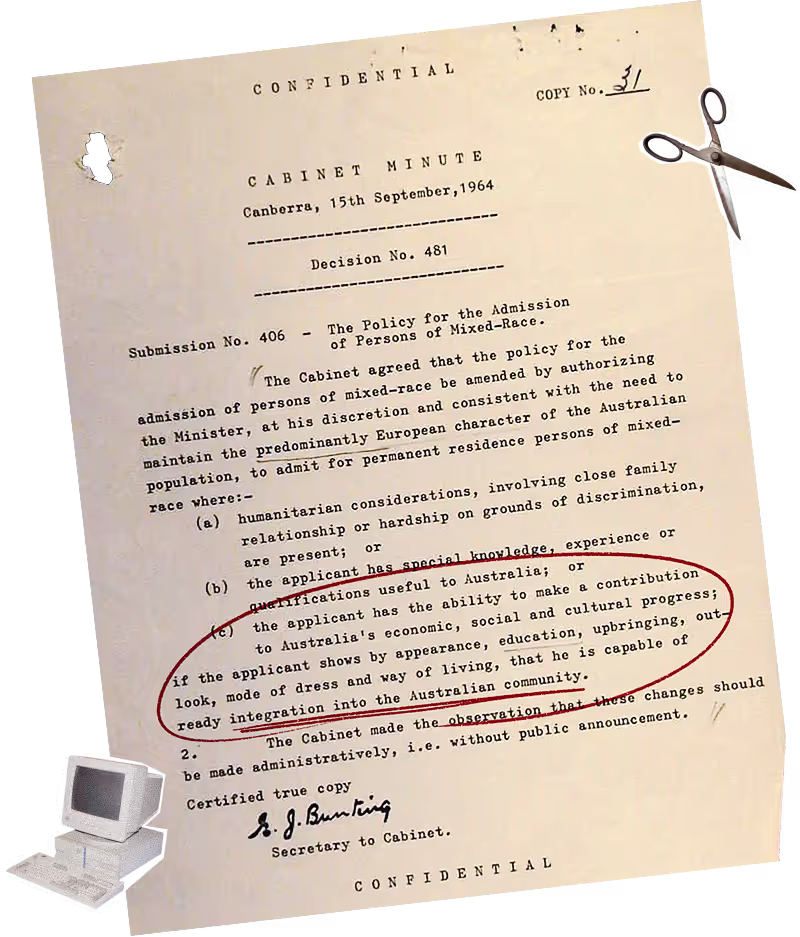
From this rhetoric, the “perfect migrant” emerges. It’s a story that paints the ideal migrant as someone who effortlessly integrates into the new society, who is healthy, hardworking and productive. It’s a migrant who gives without taking. It tells us that if we’re fortunate enough to be welcomed into this country, we must continuously prove we deserve it and that we are worth it.

These expectations are not only unrealistic, they are deeply problematic and exclusionary, especially when they don’t leave room for people who don’t fit the mold.

"That’s the unspoken demand of capitalist migration policy: not just to work, but to constantly prove your productivity."

Over time I began to internalise this narrative and ableism tangled up in it. I started seeing myself as a “double burden” and “not good enough”, and questioned whether I was worthy of being offered permanency in Australia. I carried this quiet belief that I somehow needed to compensate for the perceived “flaws” on my migration profile to offset the parts of me that didn’t align with the narrow definition of the “perfect migrant” and to prove (as much to myself and the department) that I was still deserving.
01
02
03
04
05
10
06
07
08
09
11
12
01
02
04
05
03
06
07
08
10
11
09
12
01. Prepare for my citizen test
02. Points-based rankings
03. Warm climate, the ocean
04. I drew a kangaroo
05. Three university degrees
06. Significant cost threshold
07. Mandatory health check
08. Impossibly high standards
09. Language proficiency
10. Full time work
11. Social cohesion and belonging
12. Participation in community events

“We wish you every success in becoming an Australian citizen, and in pursuing a peaceful and productive life in Australia.

Navigating an unfamiliar healthcare system on my own was daunting enough. But doing so while carrying the fear that seeking help could be used against me was isolating beyond words. I became fearful of accessing healthcare. It started very subtly but it marked the beginning of what would grow into a deep, persistent anxiety around my health.

During the years I was stuck in limbo, I wasn’t able to access the support I needed, even as it became clearer that my support needs were higher than I had initially realised. I was worried about the potential risk to my visa process and ability to stay in Australia.
   
I began withdrawing from every support service I had access to. My mental health started to deteriorate, which only reinforced the cycle. The worse I felt, the more I needed support. But the more support I needed, the more I feared it would be held against me in my visa process. As a result, my health often deteriorated to the point where I wasn't able to continue working, studying or functioning.

If we consider productivity in the way governments often frame it, this system actively undermines it. Had I been able to safely access the support I needed without fear of jeopardising my next visa, I likely would have been able to remain consistently employed and possibly graduate on time. It’s almost as if everyone benefits when we replace fear with support and empathy.

Redefining Belonging Beyond Productivity

Fast forward a decade later. I finally made it. After jumping through endless hoops and hurdles, the email I had been waiting for arrived: I had been granted permanent residency. I am safe. I can breathe. I belong (??)

Now, as I prepare for my citizenship test, I receive a handbook in my email. Everything I need to know to pass the test and become an Australian citizen! Everything I’ve always wanted! As I scroll through the handbook, I find myself stuck on a single sentence:

We wish you every success in becoming an Australian citizen, and in pursuing a peaceful and productive life in Australia.

The word productive lingers.

The language around “being a productive citizen” has always felt both aspirational and exclusionary. I’ve spent most of my life imposing impossibly high standards on myself, constantly pushing, constantly proving, just to feel like I belong. So, I pause and try to understand. What does it mean? What do they want from me? What if I’m not making enough progress? What if I’m not doing enough? What if I’m wasting the life I fought so hard to secure?

So, I did what any anxious person might do: I asked ChatGPT. It told me:‘A productive life typically refers to one where you are consistently making progress toward meaningful goals.

And then I pause. I breathe. I remind myself: I have made progress, incredible progress. The fact that I’m here, scrolling through this handbook, preparing to stand in a room and declare myself as a citizen of this country, is monumental. I’ve built a life with care and intention. I’ve held on through uncertainty and fear. I’ve lived in a state of tension for so long that sometimes I need to consciously remind myself: I am safe now.

"I wonder if I'll spend the rest of my life living in fear. Will I ever feel comfortable being open about my disabilities?"

And with that, something in me shifted. I began to change my perspective, to redefine what “meaningful goals” look like. Not according to the government, not what is expected from me, but through what matters to me.

For me, it looks like intentionality. It looks like making progress in ways that feel grounded, nurturing and rewarding. It looks like finding balance between work and the time I dedicate to caring for myself.

I am a citizen now, but the tension continues to live in my body. The fear of not being “enough”, not healthy enough, not stable enough, not productive enough. The incredibly high standards and the constant need to prove myself to be worthy and accepted is something the migration system planted in me long ago, and something I have to work to challenge every day.

It remains difficult for me to let go of the “give not take” mindset and the guilt that comes with it. I still feel discomfort each time I use Medicare, even for the most routine GP appointments.

I wonder if I'll spend the rest of my life living in fear. Will I ever feel comfortable being open about my disabilities? I think it shows just how traumatic and frightening the migration experience was. It led to a lot of internalised ableism, and even years later, I still struggle to feel comfortable with myself or to accept the help I need.
I currently work in the so-called settlement sector, and anyone who has spent time in this space will tell you that the phrases you hear most often are social cohesion” and belonging.” Although these ideas sound positive, they often feel conditional, tied to how well someone conforms to expected norms. Social cohesion initiatives frequently focus on visible markers of integration such as employment, language proficiency, or participation in community events, without addressing the deeper, intersectional dimensions of belonging. 

Many people are forced to navigate multiple systems of exclusion while being measured against a single standard of “successful integration”. For individuals whose identities intersect with marginalised experiences, such as disability, the promise of belonging can feel distant and fragile.

To truly be a welcoming nation and achieve true unconditional belonging, we must confront the roots of these systems and acknowledge that our migration system is inherently ableist. Australia must move beyond its narrow definitions of worth. We need to dismantle systems that treat disabled migrants as risks and burdens. 

This is a radical reframe: the right to stability, to live in a safe country, the right to care for ourselves, the right to build full, complex and joyful lives. These are central to the principles of disability justice, which affirms that we are worthy simply because we exist.  

And let’s be clear: migrants do contribute. We sustain industries, hold communities together. We advocate, create and care. And we do all this while navigating a labyrinth of bureaucracy and cultural expectations. 

But systems built on profit aren’t designed to recognise care or culture as contributions. They don’t account for the invisible labour of navigating discrimination, or the strength it takes to exist in spaces not built for you. And it’s time to ask: Who gets to be seen as “deserving” of a life in Australia and who is being left behind?

Because, when we create a hierarchy of worth, we don’t just devalue disabled migrants, we silence them. We erase the contributions that don’t show up on tax returns.

“Let’s be clear: migrants do contribute. We advocate, create and care. And we do all this while navigating a labyrinth of bureaucracy and cultural expectations.”

Iga Morzynska
Iga Morzynska (she/they) is a disability advocate, currently working as a Policy and Programs Coordinator at the Settlement Council of Australia, a national peak body for newly arrived migrants and refugees.They have a strong interest in health systems, disability policy, and equity in access to services, particularly at the intersection of migration, disability, and mental health. As a migrant herself, Iga brings her own lived experience of migration, disability, and mental health to their work.