
















































00
01
02
03
04
05
06
07
08
09
10
11
12
13
14
15
16
17
18
19
20
21
22
/22
Section 00 | Before we begin
Section 01 | Leaving
Section 02 | Arriving
Section 03 | Waiting
Section 04 | Staying
Section 05 | What comes next?
issue 02
March 2026
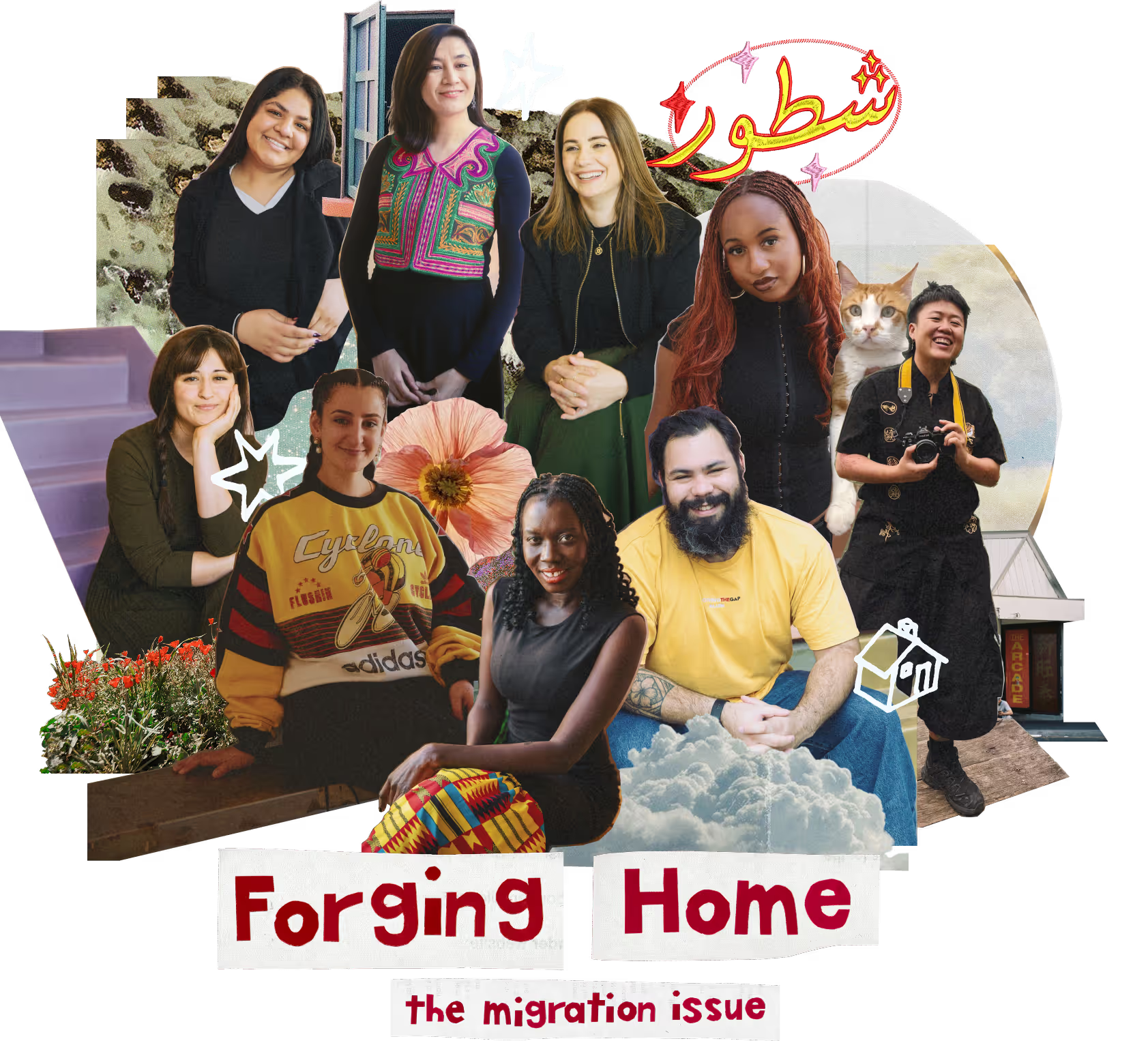
Rather than define migrants by our movement across borders, this issue is about the ever-continuous and non-linear journey migrants take to forge for ourselves a home.
Collage of smiling portraits showcasing contributors of Issue 02. A title sits before that read Forging Home: The Migration Issue
acknowledgement statements
Rally Magazine acknowledges with a deep gratitude the communities, ancestors and Elders of the Wurundjeri people of the Kulin Nations, the unceded lands on which we live, learn and grow. We recognise your sovereignty as the enduring custodians of the waterways, sky, and earth Country, from where these stories sprang. We recognise your reciprocal connection to Country, relationships that must be prioritised and honoured.

We recognise all Aboriginal and Torres Strait Islanders as this land’s first custodians, storytellers, and caretakers of the world’s oldest continuous living cultures.

We would also like to recognise and thank our own elders, ancestors, communities, and storytellers, and honour the connection of all Indigenous peoples and their homes.
This issue uses a human rights-based approach to explore the context of migration in so-called Australia. As opposed to an economic lens, this approach brings the treatment of all migrants, regardless of our status or contribution to society, to the forefront of all discussions. Learn more about this approach here.

This issue recognises:
  1. broad and varied migration/displacement experiences outside of legal definitions. For example, someone can be a refugee even if they have not been deemed a refugee by a legal system
  2. First Nations perspectives in conversations about displacement, as internally displaced people on the lands we work on
  3. the continuing tension of migrating to and settling on stolen land in so-called ‘multicultural Australia’.
We approached this issue through a cultural safety framework developed in collaboration with Unbound Stories and our guest editor, Samah Shda. You can read more about how we uphold this framework across the full production process here.
letters from the editors

"Home is an

ongoing

practice

OF

MEMORY,

resistance,

care

and

imagination."

"Home

is an

ongoing

practice

OF memory

resistance,

care and

imagination."

I  have spent most of my life being asked to explain myself.

Why I left.
What I survived.
How grateful I am.
How far I’ve come.

Sometimes these questions are asked with care. Often they are asked with urgency, as if my humanity needs to be proven quickly, efficiently, and in a way that reassures the listener. Over time, I learned the shape of the story that was expected of me. I learned where to compress pain, where to insert resilience, and where to land the narrative so it could be received.

I also learned what parts of myself were never invited in.

Read guest editor Samah's full letter...

An envelope with the text 'Read the entire letter here' and a label that reads 'Click here'
You don’t have to convince us that storytelling matters. We created this whole magazine clinging to this belief – that humans are moved to action not by guilt and statistics, but by empathy unlocked with carefully selected words and images. 

As a mag on a mission to not just be read but rallied behind, after we choose our topic for an issue, we naturally spend a lot of time thinking about our audience. What are the main barriers to understanding? What are the myths we need to debunk? How can we make sure the audience best recognises our humanity? 

But when stories are always designed with the audience in mind, what does this do to the storyteller? This was the first question our guest editor, Samah, taught us to ask and this is the lesson that has taken us, admittedly, the process of producing this issue to really understand. 

Read founders Ange + Baya's full letter...

An envelope with the text 'Read the entire letter here' and a label that reads 'Click here'
Before we begin
Before we begin
Before we begin
Before we begin
Before we begin
Before we begin
Before we begin
Before we begin
Before we begin
Before we begin

Before we begin

Stories about migration don’t exist in a vacuum. In so-called Australia, they’re often told through headlines, policy debate and language that quietly assigns value – who is deserving, who is a risk, who belongs and who doesn’t. These values shape public opinion, perpetuate myths and quietly manipulate how we receive these stories.

We’ve included this section to offer shared context before you enter the issue itself – not to tell you what to think, but to help create the conditions for reading with care. For meeting these stories as expressions of full humanity, rather than evidence, explanations or exceptions.

We also cannot have a conversation about migration in this country without first acknowledging, discussing and critiquing the reality of migrating to and settling on stolen land. Forging home after displacement is an experience shared between migrants in this country and the first custodians of these lands, and we invite you to sit with us as we unpack these layers.

What does that term mean?

Swipe across

Migrant

An umbrella term to refer to any person who moves away from their usual place of residence, whether internally within their country of origin or across a border, and whether that movement is ‘forced' or voluntary.

(UNHCR – Migration Definition)

Forcibly displaced person

A broad term that captures the experiences of people forced to leave the place they used to call home and cannot safely return to.

(UNHCR – Refugee Data Finder)

Internally displaced people

People who are still living within the internationally recognised borders of their home country, but have had to physically leave their house due to persecution, conflict, violence, human rights violations or events seriously distributing public order. At current, this number does not include displacement as a result of climate change events.
(UNHCR – Refugee Data Finder)

Refugees

People with determined protection status. For example, they may hold a refugee visa and reside in a country outside their home country with full citizenship rights.

(UNHCR – Refugee Data Finder)

Asylum seekers

People in need of protection who are actively seeking refugee status but have yet to be determined.

(UNHCR – Refugee Data Finder)

Bicultural

The state of belonging to and identifying with two distinct cultural groups. It involves navigating and integrating the values, customs, language, and/or social norms of both cultures into one’s sense of self.

(Oxford Review)

Third culture kid

A term coined by US sociologist Ruth Hill Useem in the 1950s, for children who spend their formative years in places that are not their parents’ homeland.

(BBC)

First-generation / Second-generation

The first generation consists of individuals who have moved to a new country. Their children, born in that country to at least one foreign-born parent, are classified as second-generation immigrants.

(EBSCO)

Some common questions

Some common questions

Why are people displaced?
Click to learn more
Tap to learn more
What share of the world’s forcibly displaced population does Australia currently look after?
What is Australia’s responsibility towards forcibly displaced people?
How does Australia’s Refugee and Humanitarian Program work?
Why doesn’t Australia take in more refugees?
The resettlement process for refugees in Australia is costly. But it’s worth interrogating which parts of this process are costing us the most.

Of the approximately $4.8 billion that Australia invests into the Department of Home Affairs, only 22% goes towards resettlement and support services for migrants and refugees. 

78%, instead, goes towards measures designed to ‘protect’ our borders. Of this already significant portion of the department’s budget, almost half goes towards mandatory detention

Offshore detention continues to be run by private prison operators at alarming costs with little transparency. In September 2025, The Guardian reported we will be paying $157 million to a US operator to run offshore processing in Nauru, which held a little over 100 people at the time. That’s $1.57 million per asylum seeker

Most significantly, the Australian Government has the power to detain people in both onshore and offshore immigration detention indefinitely – a practice that has been determined as arbitrary and a violation of fundamental human rights. In fact, the United Nations Human Rights Council has made this determination six times now

The privatisation and indefinite nature of our mandatory detention system makes little sense whether you look at it from an economic lens or a human rights lens. The budget that’s supposed to go towards our humanitarian commitments is instead spent upholding this deeply flawed system. 
The total number of places available in our Refugee and Humanitarian Program is decided every year in the Federal Budget. This number represents the total number of people MAX that the Department of Home Affairs is allowed to grant a Refugee Visa.

Currently, people in Australia who are seeking asylum but do not have a valid visa are required by law to be detained where they cannot leave. It’s important to know that while in these facilities, most people do not have access to Centrelink, Medicare or work rights. Paired with the fact that Australia can currently detain asylum seekers indefinitely, this is a major violation of fundamental human rights. In fact, the United Nations Human Rights Council has made this determination six times now.

In September 2012, Australia started intercepting boats carrying people seeking asylum and detaining them instead at processing centres in neighbouring Nauru and Manus Island. People seeking asylum previously detained onshore were also and continue to be sent offshore to these islands.

Offshore processing was essentially designed to deter people coming to Australia for protection by boat. The conditions, as well as its treatment of asylum seekers within these facilities, have been widely criticised. Reports of insufficient water supply and sanitation, high temperatures and humidity, as well as inadequate healthcare are frequent. 

Just because asylum seekers detained in Nauru and Manus Island are not on Australian soil, we still remain responsible for their treatment and should be held accountable for the violations against human rights that occur there.
In 1951, responding to mass displacement after World War II, the United Nations created the Refugee Convention.

This is an international legal document that defines:
  • who is a refugee
  • their human rights
  • the legal obligation we all have towards upholding them.
Australia, along with 143 other countries, signed this convention.

With this signature, we agreed that people who are found to be refugees will not be sent back to a country where their life or freedom would be threatened.
At the end of 2024, we had a total of 117,313 forcibly displaced people in Australia (Department of Home Affairs).

This accounted for less than 0.2% of the global refugee and asylum seeker population (UNHCR).

Australia hosts 1.3 refugees for every 1,000 residents. A huge difference compared to Iran (41.5), Turkey (37.3), Germany (30.7) and Greece (18.8). 

You can explore a map showcasing refugees for every 1,000 residents across the world here
There is no single cause. But if you trace many displacement stories back far enough, patterns emerge.

Colonialism has played – and continues to play – a major role in forced displacement across the world. European empires removed Indigenous peoples from their lands, extracted resources and imposed borders that still shape conflict today.

This was, of course, Australia’s first experience with displacement too. Today, only 24% of Aboriginal and Torres Straight Islander people live on their homeland, yet scholars of forced placement have traditionally not included Indigenous Australians in figures of internally displaced peoples globally.  

Outside of Australia, the repercussions of colonialism continue to displace people. A large majority of forcibly displaced people originate from the Global South, where ‘formerly’ colonised countries are left under-resourced, dispossessed and divided following the theft of resources, wealth and people. In this sense, many of the world’s current conflicts can be traced back to colonial histories.

It may feel easier to isolate today’s conflicts to their modern triggers, but it’s deeply important to consider the legacy of colonialism as the root cause of migration, and especially forced migration, historically and now. We highly recommend reading this article by the Migrants' Rights Network to further understand this connection.

Today, other recognised drivers for displacement include environmental drivers such as drought, social drivers such as limited education opportunities, political drivers such as corruption, and economic drivers such as poverty.
There is no single cause. But if you trace many displacement stories back far enough, patterns emerge.

Colonialism has played – and continues to play – a major role in forced displacement across the world. European empires removed Indigenous peoples from their lands, extracted resources and imposed borders that still shape conflict today.

This was, of course, Australia’s first experience with displacement too. Today, only 24% of Aboriginal and Torres Straight Islander people live on their homeland, yet scholars of forced placement have traditionally not included Indigenous Australians in figures of internally displaced peoples globally.  

Outside of Australia, the repercussions of colonialism continue to displace people. A large majority of forcibly displaced people originate from the Global South, where ‘formerly’ colonised countries are left under-resourced, dispossessed and divided following the theft of resources, wealth and people. In this sense, many of the world’s current conflicts can be traced back to colonial histories.

It may feel easier to isolate today’s conflicts to their modern triggers, but it’s deeply important to consider the legacy of colonialism as the root cause of migration, and especially forced migration, historically and now. We highly recommend reading this article by the Migrants' Rights Network to further understand this connection.

Today, other recognised drivers for displacement include environmental drivers such as drought, social drivers such as limited education opportunities, political drivers such as corruption, and economic drivers such as poverty.
Exit button
At the end of 2024, we had a total of 117,313 forcibly displaced people in Australia (Department of Home Affairs).

This accounted for less than 0.2% of the global refugee and asylum seeker population (UNHCR).

Australia hosts 1.3 refugees for every 1,000 residents. A huge difference compared to Iran (41.5), Turkey (37.3), Germany (30.7) and Greece (18.8). 

You can explore a map showcasing refugees for every 1,000 residents across the world here
Exit button
In 1951, responding to mass displacement after World War II, the United Nations created the Refugee Convention.

This is an international legal document that defines:
  • who is a refugee
  • their human rights
  • the legal obligation we all have towards upholding them.
Australia, along with 143 other countries, signed this convention.

With this signature, we agreed that people who are found to be refugees will not be sent back to a country where their life or freedom would be threatened.
Exit button
The total number of places available in our Refugee and Humanitarian Program is decided every year in the Federal Budget. This number represents the total number of people MAX that the Department of Home Affairs is allowed to grant a Refugee Visa.

Currently, people in Australia who are seeking asylum but do not have a valid visa are required by law to be detained where they cannot leave. It’s important to know that while in these facilities, most people do not have access to Centrelink, Medicare or work rights. Paired with the fact that Australia can currently detain asylum seekers indefinitely, this is a major violation of fundamental human rights. In fact, the United Nations Human Rights Council has made this determination six times now.

In September 2012, Australia started intercepting boats carrying people seeking asylum and detaining them instead at processing centres in neighbouring Nauru and Manus Island. People seeking asylum previously detained onshore were also and continue to be sent offshore to these islands.

Offshore processing was essentially designed to deter people coming to Australia for protection by boat. The conditions, as well as its treatment of asylum seekers within these facilities, have been widely criticised. Reports of insufficient water supply and sanitation, high temperatures and humidity, as well as inadequate healthcare are frequent. 

Just because asylum seekers detained in Nauru and Manus Island are not on Australian soil, we still remain responsible for their treatment and should be held accountable for the violations against human rights that occur there.
Exit button
The resettlement process for refugees in Australia is costly. But it’s worth interrogating which parts of this process are costing us the most.

Of the approximately $4.8 billion that Australia invests into the Department of Home Affairs, only 22% goes towards resettlement and support services for migrants and refugees. 

78%, instead, goes towards measures designed to ‘protect’ our borders. Of this already significant portion of the department’s budget, almost half goes towards mandatory detention

Offshore detention continues to be run by private prison operators at alarming costs with little transparency. In September 2025, The Guardian reported we will be paying $157 million to a US operator to run offshore processing in Nauru, which held a little over 100 people at the time. That’s $1.57 million per asylum seeker

Most significantly, the Australian Government has the power to detain people in both onshore and offshore immigration detention indefinitely – a practice that has been determined as arbitrary and a violation of fundamental human rights. In fact, the United Nations Human Rights Council has made this determination six times now

The privatisation and indefinite nature of our mandatory detention system makes little sense whether you look at it from an economic lens or a human rights lens. The budget that’s supposed to go towards our humanitarian commitments is instead spent upholding this deeply flawed system. 
Exit button

Finding

my

way

home

"Life had continued to be consistently challenging, presenting obstacles preventing me from returning with my family to home Country. Until I return Home, I don’t know that I will ever fully feel at peace again."
letter
12 Min read
A label that reads 'Enter article'
Click each article to read more
Tap each article to read more
RALLY X REFUGEE COUNCIL OF AUSTRALIA PRESENTS

Settling on
stolen land

Five first nations people from across the world sit, sip and share in solidarity their experiences living off country and settling on stolen land.
partnership content: letter and video roundtable
3 min read & 50 Min watch
A label that reads 'Enter article'
PART 1: LEAVING
PART 1: LEAVING
PART 1: LEAVING
PART 1: LEAVING
PART 1: LEAVING
PART 1: LEAVING
PART 1: LEAVING
PART 1: LEAVING
PART 1: LEAVING
PART 1: LEAVING

Prejudice, pursuits and pets. Part 1 explores why  we leave the places we once called home and what  we could not bear to leave behind.

When did you know you had to leave?

Transphobia, homophobia, bomb explosions. Charlie*, Anastasia Le and Samah Shda share why they left the places they once called home.
*name has been changed
Video Series
3 Min watch
Video Series
3 Min watch

What’s one thing you were able to take with you?

Memories – in material and in mind. Samah Shda, Anastasia Le and Charlie* share what they brought with them as they left home.
*name has been changed
Video Series
2 Min watch
Video Series
2 Min watch

What’s one thing you had to leave behind?

Diaries, friendships, community. Samah Shda, Charlie* and Anastasia Le share what they could not bring with them as they left home.
*name has been changed
Video Series
4 Min watch
Video Series
4 Min watch
The words 'In pursuit of safety'
Having physical safety doesn't mean all the other safeties fall into place. This story is about the pursuits of safety – safety of the soul and safety of the self.
personal narrative
5 Min read
A label that reads 'Enter article'

GOING BACK

for a cat

GOING BACK

GOING BACK

for a cat

for a cat

Do you have any pets? Do you consider them family? Would you take them with you if you had to flee the country? If you couldn’t take them with you – would you go back for them later?
personal narrative
15 Min read
A label that reads 'Enter article'

"I accepted that this was how I was going to live – locked in a closet I'd built myself, with chains I'd tied and a combination only God knew."

part 2: ARRIVING
part 2: ARRIVING
part 2: ARRIVING
part 2: ARRIVING
part 2: ARRIVING
part 2: ARRIVING
part 2: ARRIVING
part 2: ARRIVING
part 2: ARRIVING
part 2: ARRIVING

Power, productivity and the psychological impact of storytelling for survival. Part 2 explores how crossing borders can change the way we see ourselves forever.

What’s a change you wish to see for migrants arriving?

Belonging, power, access. Anastasia Le and Charlie* share their hopes for the future of migrants arriving in Australia.
*name has been changed
Video SEries
3 Min watch
Video SEries
3 Min watch

What impressions did you have about Australia?

Beaches, diversity, acceptance. Charlie*, Anastasia Le and Samah Shda share what they expected when arriving to Australia.
*name has been changed
Video SEries
5 Min watch
Video SEries
5 Min watch
A stack of papers with the words 'Prove your Productivity' written on top
“We wish you every success in becoming an Australian citizen, and in pursuing a peaceful and productive life in Australia.” That’s the unspoken demand of capitalist migration policy: not just to work, but to constantly prove your productivity.
feature
12 Min read
A label that reads 'Enter article'
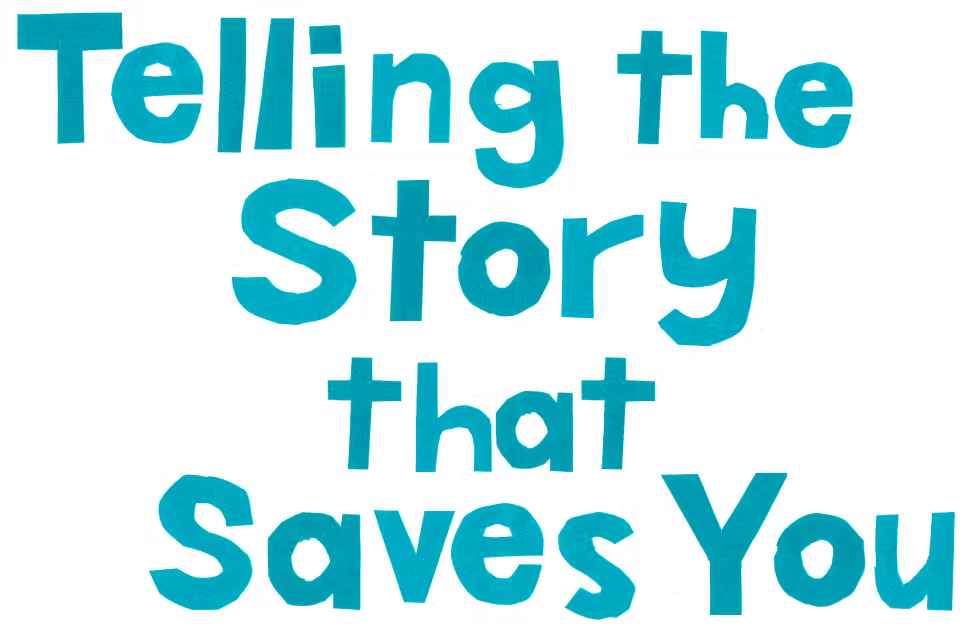
Cutout text that reads Telling The Story That Saves You
Storytelling is something we all do. But when storytelling becomes a matter of survival, how does this change us as people? How can we create safer spaces for refugees to explore the full humanity of their stories?
partnership content with unbound stories
19 Min read
A label that reads 'Enter article'

Recipes from home

Recipes flavoured with history, heartache and home.
RECIPES & FORWARDS
3 Min READ
A label that says 'Read recipe'

Savta's Shishkelach

A label that says 'Read recipe'

Linda's Tabouli

A label that says 'Read recipe'

Ammah's Batticaloa-Style Parippu (Dhal)

A label that says 'Read recipe'

Savta's Shishkelach

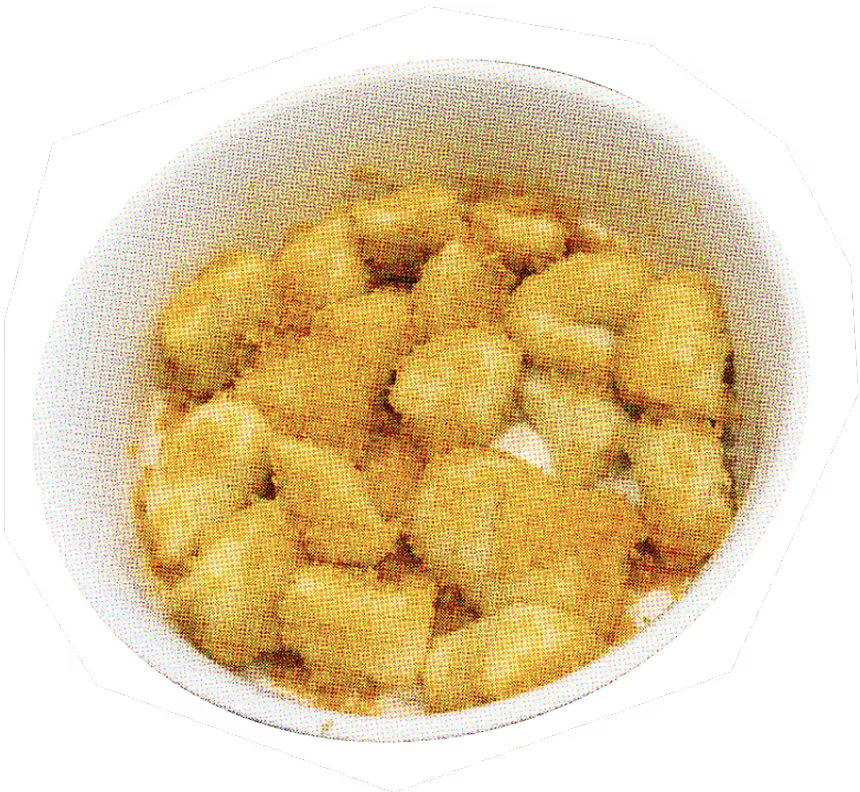
While studying for a semester in Copenhagen, I longed for food that felt like home. So I travelled back to my Savta’s (grandmother’s) hometown in Bratislava, Slovakia in search of a dish she used to lovingly prepare for me: shishkelach, a type of gnocchi covered in rich olive oil and golden flakey breadcrumbs. But when I arrived, I could only find strange variants of twisted noodles smothered in sugar or cheese. 
Everything in Bratislava had this same feeling of being familiar yet off, like wearing your favourite coat but two sizes too big. When I visited my Savta’s apartment where she grew up, it dawned on me that while Bratislava may have been her hometown, it certainly did not act like a home where she belonged when, at 12 years old, she was kicked out of then-Czechoslovakia and sent to the concentration camp Auschwitz. 
It’s this dissonance between a culture intrinsic to your history and one that rejected your inclusion in it that makes travelling Europe as a Jew often a disconcerting feeling – revisiting the remnants of your ancestry that is now marked by its absence.
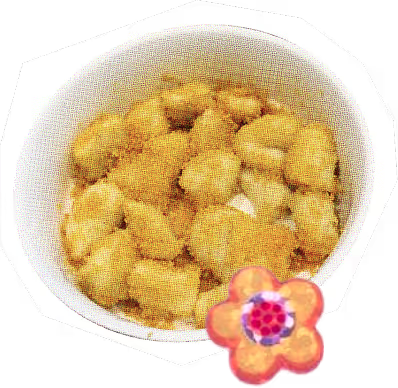
When I returned to Copenhagen, I called my Savta and asked her to teach me her recipe for shishkelach, so that I could finally feel at home wherever I went.
– Talia Slonim

A hand drawn orange label with the words 'recipe' on it
Potatoes (yellow or russet is fine)
Plain flour
Egg
Extra virgin olive oil
Cornflake bread crumbs
Salt
* (unfortunately no quantities were provided by my Savta – I was told to just ‘feel it out’)
A hand drawn orange label with the words 'ingredients' on it
  1. Boil the potatoes until soft, approximately 20 minutes. You can check if they’re done by piercing them with a fork.
  2. Peel the potatoes and either finely grate or mash them in a bowl.
  3. Add an egg, flour and some salt to the ground potatoes. 
  4. Knead the mixture until it becomes a dough. Add more flour if the mixture feels too wet.
  5. Flour your work bench and knead the dough out into a thick large rectangle. Cut the dough into long cylinders, and then again into smaller pieces the size of your thumb.
  6. Bring a pot of salted water to the boil. Carefully drop the small pieces into the water, making sure they don’t stick to the bottom.
  7. Once they have floated to the surface, cook for another minute or so and then sift them out.
  8. Coat in lots of extra virgin olive oil, gritty breadcrumbs and salt.
A hand drawn orange label with the words 'method' on it
Exit button

Linda's Tabouli

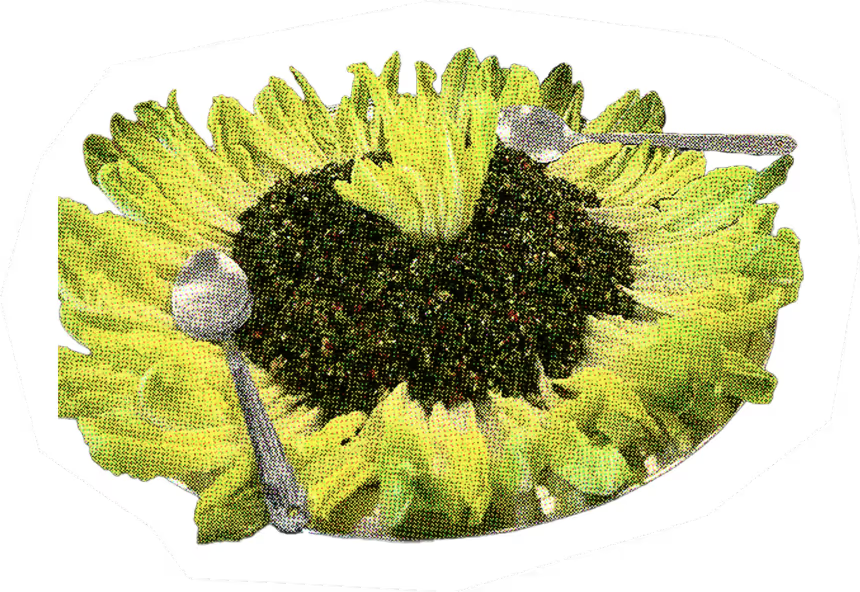
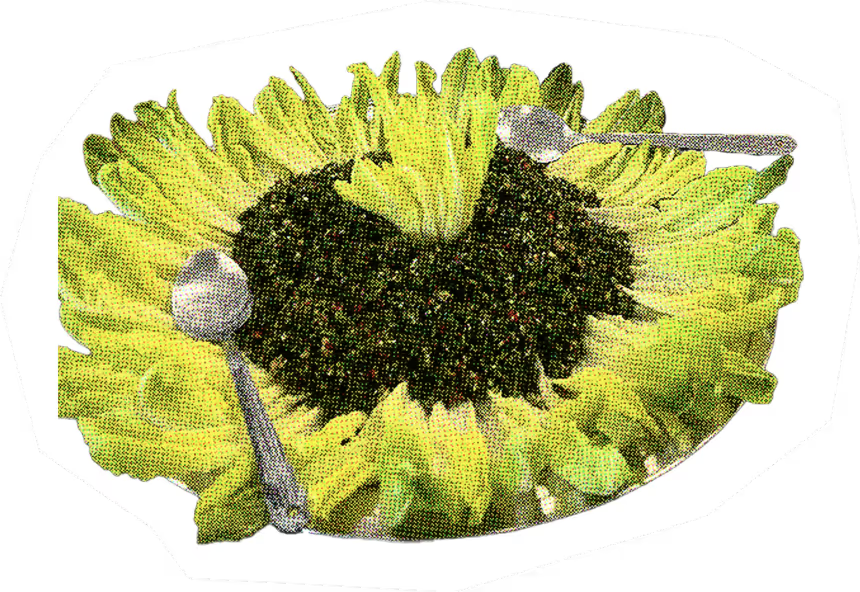
At first glance, tabouli seems like a simple salad. It doesn’t even have lettuce. But the reality of a great tabouli is that there is time, care and family history put into every ingredient, in every step. It is a recipe with opinions that have spanned generations from my mum Linda, Teta تيتا  and Jiddo جدو. Perhaps their endless debates about the perfect tabouli – do you season the tabouli with cumin, mixed spice or black pepper or why the mint needs to be layered between the parsley and spring onion to prevent it from oxidising – is really an open analysis on my family’s generational OCD, but at least it tastes delicious.
Tabouli is all about balance: the ingredients are chopped, very fine but without bruising the parsley. I remember my grandmother would always toss the salad with her hands to ensure that all the ingredients were mixed together evenly. Capsicum is not traditionally put in tabouli, but my Jiddo جدو likes it that way, and taught my mum the same. And she’s added her own secret ingredient, which is a banana chilli without the seeds. The tradition is passed down but with a little twist.
My only contribution to my family's tabouli discourse – and my favourite part – is taste testing to see if it’s missing anything before it is served.
– Anna Emina
A hand drawn purple label with the word 'ingredients' written on top
2 parsley bunches
1 spring onion bunch (alternatively
1 large brown or Spanish onion)
1 fresh mint bunch
1 red capsicum
4 tomatoes
2 Lebanese cucumbers
Juice 2 to 4 lemons 
Add salt and pepper
1 cup extra fine burgul
Extra virgin olive oil
A hand drawn purple label with the word 'method' written on top
  1. Wash, dry and finely chop parsley, spring onion (alternatively large brown or Spanish onion), fresh mint, red capsicum, tomatoes and Lebanese cucumbers.
  2. Juice 2 to 4 lemons (to your liking).
  3. Add salt and pepper.
  4. Add salt and pepper.
  5. Generous drizzle of good quality extra virgin olive oil.
  6. Add 1 cup extra fine burgul soaked and strained.
  7. Toss all ingredients in bowl.
  8. Serve and enjoy!
Serving suggestion:
Plate tabouli on a bed of lettuce (of your choice).
Exit button
A hand drawn pink cloud and the words 'recipe' written inside

Ammah’s Batticaloa-style Parippu (Dhal)

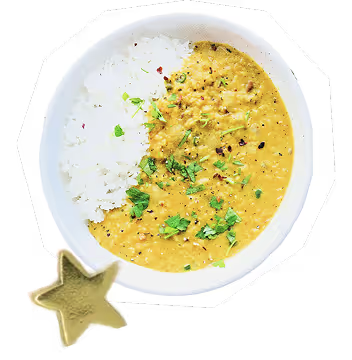
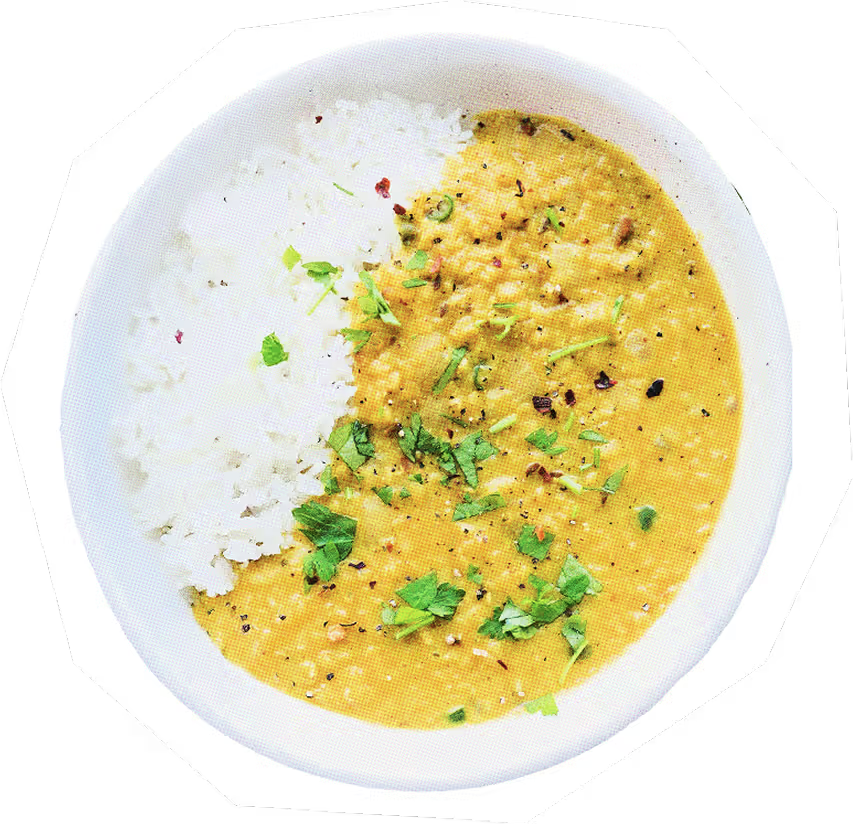
I just turned 41 and finally I am doing something I should have done a long time ago – meeting my ammah (mother) in the kitchen to learn. Learning to cook with ammah for this piece feels like arriving late to a table that has always been set for me. As a child, I learned that love could look like distance. As a humanitarian aid worker for Oxfam and a gender specialist, ammah’s work pulled her across borders and time zones; many evenings her chair stood empty, many mornings I left for school without her waving at the door. Yet even then we knew her absence was something like a bridge between our kitchen and other kitchens where hunger and hope sat side by side. Places like the Eastern province of Sri Lanka where my ancestors come from, and this recipe too. 
Now, in her last chapter, when memory loosens its grip and names drift like curry leaves, we stand together over a stove. I watch her hands remember what her mind sometimes cannot. She measures by feel, seasons by instinct, tells stories as the mustard seeds pop. Each step is like a sentence she once spoke in rooms where hope had worn thin but she was there with her communities, leaning in anyway.
Cooking with her now is to get some time back. It gathers the years into the palm of my hand and teaches me that love, finally, comes home. I am learning not just recipes, but how to carry her forward, how to feed others with what she fed the world.
– Shankar Kasynathan
A hand drawn pink cloud and the words 'ingredients' written inside
Main
1 cup red split lentils (masoor dhal)
2½ cups water
1 cup coconut milk
1 small brown onion, finely sliced
2 cloves garlic, lightly crushed
1 small piece fresh ginger (about thumb-sized), sliced

Tempering (this matters!)
2 tbsp vegetable oil or coconut oil
½ tsp black mustard seeds
1 sprig fresh curry leaves
Spices
½ tsp turmeric powder
½ tsp ground cumin
½ tsp ground coriander
½ tsp chilli powder (or less – Batticaloa heat is restrained)
Salt to taste

Optional (but very Batticaloa1)
small green chilli, slit lengthwise
A squeeze of lime juice at the end
A hand drawn pink cloud and the words 'method' written inside
  1. Cook the dhal
    - Rinse the red lentils until the water runs mostly clear.
    - Add lentils and water to a saucepan.
    - Bring to a boil, then simmer gently for 15-20 minutes.
    - Skim off any foam.

    - Cook until lentils are very soft, just starting to break down (not soupy yet). *Batticaloa dhal is soft, almost porridge-like, not grainy.
  2. Build the flavour
    - Add turmeric, cumin, coriander, chilli powder and salt to the pot.
    - Add onion, garlic, ginger and green chilli.
    - Simmer for another 5-7 minutes until onions soften.
  3. Add coconut milk
    - Stir in coconut milk.
    - Simmer gently (do not boil hard) for 5 minutes.
    - Taste and adjust salt.
    - The colour should be pale golden, not dark or oily.
  4. Temper (the soul of the dish)
    - Heat oil in a small pan.
    - Add mustard seeds (let them pop!).

    - Add curry leaves (they will crackle!).
    - Immediately pour the hot oil and leaves over the dhal.
    - Cover for 1 minute. Let it settle.
  5. Finish
    - Optional squeeze of lime juice.
    - Stir once, gently.
*Why this recipe is specifically from the east of Sri Lanka
  • No tomato (important).
  • No garam masala.
  • tard and curry leaf tempering, not onion-heavy frying.
  • Comfort food made to sit quietly next to rice and fish, not dominate the plate.
Exit button

"The constant need to prove myself to be worthy and accepted is something the migration system planted in me long ago, and something I have to work to challenge every day."

part 3: waiting
part 3: waiting
part 3: waiting
part 3: waiting
part 3: waiting
part 3: waiting
part 3: waiting
part 3: waiting
part 3: waiting
part 3: waiting

Dreaming, tending, resting, searching, fighting,  creating, exchanging, choosing, enjoying. Part 3  explores how life grows even in limbo.

What do you wish people understood about waiting?

Exhaustion, compassion, dreams. Samah Shda, Charlie* and Anastasia Le share the unseen parts of prolonged waiting.
*name has been changed
Video SEries
3 Min watch
Video SEries
3 Min watch

When did you have to wait in your resettlement period.

Rejection, uncertainty, investment. Samah Shda, Anastasia Le and Charlie* share what it feels like to be stuck in waiting.
*name has been changed
Video SEries
7 Min watch
Video SEries
7 Min watch

What change do you wish to see for temporary visa holders?

Flexibility, access, power. Anastasia Le shares the changes she wishes to see.
Video SEries
2 Min watch

Here

at

home

What makes a home for someone living in the diaspora? With family, culture, language, community, food and identity spread across lands, home is here as much as it is there.
multimedia diary
5 Min read
A label that reads 'Enter article'
Bete has been waiting for a permanent visa for over 12 years. Grace is a disabled writer. They sit down to talk about their friendship and the choice to fight for what’s right despite it all.  
podcast & transcript
20 min listen or 15 Min read
A label that reads 'Enter article'
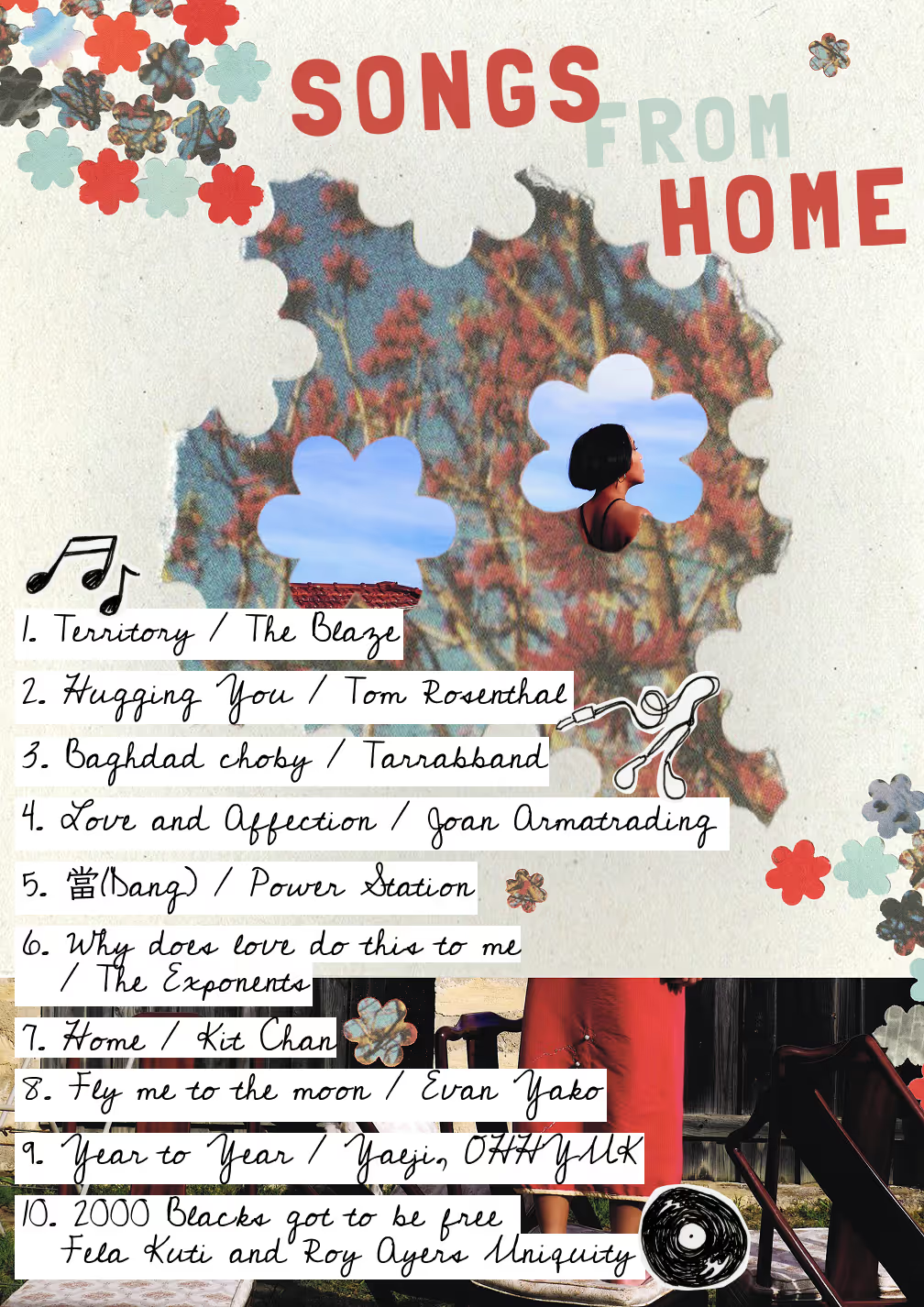
A crowd-sourced playlist where contributors and collaborators answer the following question: What song makes you feel at home?
cover art by gabby loo
PLAYLIST
33 Min listen
33 Min listen
Click here to listen
Tap here to listen

"What are you going to do? I know my situation, but today I'm going to make barbecue, coffee. Enjoy. Relax. I just choose to enjoy and forget things. And tomorrow I'll give back to my visa."

Part 4: staying
Part 4: staying
Part 4: staying
Part 4: staying
Part 4: staying
Part 4: staying
Part 4: staying
Part 4: staying
Part 4: staying
Part 4: staying

Remembering, repurposing, resisting. Part 4  explores how our roots reach across time and  space to carry our homes inside us.

What does the home you left look like?

Life, food, coldness. Samah Shda, Charlie* and Anastasia Le share what home used to look like.
trigger warning: suicidal thoughts
*name has been changed
Video SEries
4 Min watch
Video SEries
4 Min watch

What helps you feel connected to your home country?

Humour, language, Mahjong. Samah Shda, Anastasia Le  and Charlie* share what keeps them connected to their past homes.
*name has been changed
Video SEries
2 Min watch
Video SEries
2 Min watch

What’s one thing that helps you find home in Australia?

Vegemite, ocean pools and the woman in me. Samah Shda and Anastasia Le share what makes them feel at home here in Australia.
Video SEries
2 Min watch

What’s one change you hope to see for migrants ?

Wholeness, rights, microaggression. Samah Shda, Charlie* and Anastasia Le share their hopes for the future of migrants in Australia.
*name has been changed
Video SEries
4 Min watch
Video SEries
4 Min watch

Systemic

to

barriers

to

to

forging

home

A guide to understanding how systemic biases block our ability to forge home in Australia as migrants, even after we receive a permanent visa.
Explainer
6 Min read
A label that reads 'Enter article'

What's

in

a

(n

African)

name?

Where we often lose parts of our family and antecedents to plights into an Australian society, our names provide a root.
feature
10 Min read & 25 min watch
A label that reads 'Enter article'

Safa El

Samad

Resisting

Through

Creativity

How do we make use of what we already have, instead of always creating something new? How can we stitch together cultural connections separated by generations, movement and assimilation? And how can we carve out a space for ourselves instead of waiting for others to step aside?
INTERVIEW
15 min read
A label that reads 'Enter article'

on my

phone

in my

bones

on my

phone

on my

phone

in my

bones

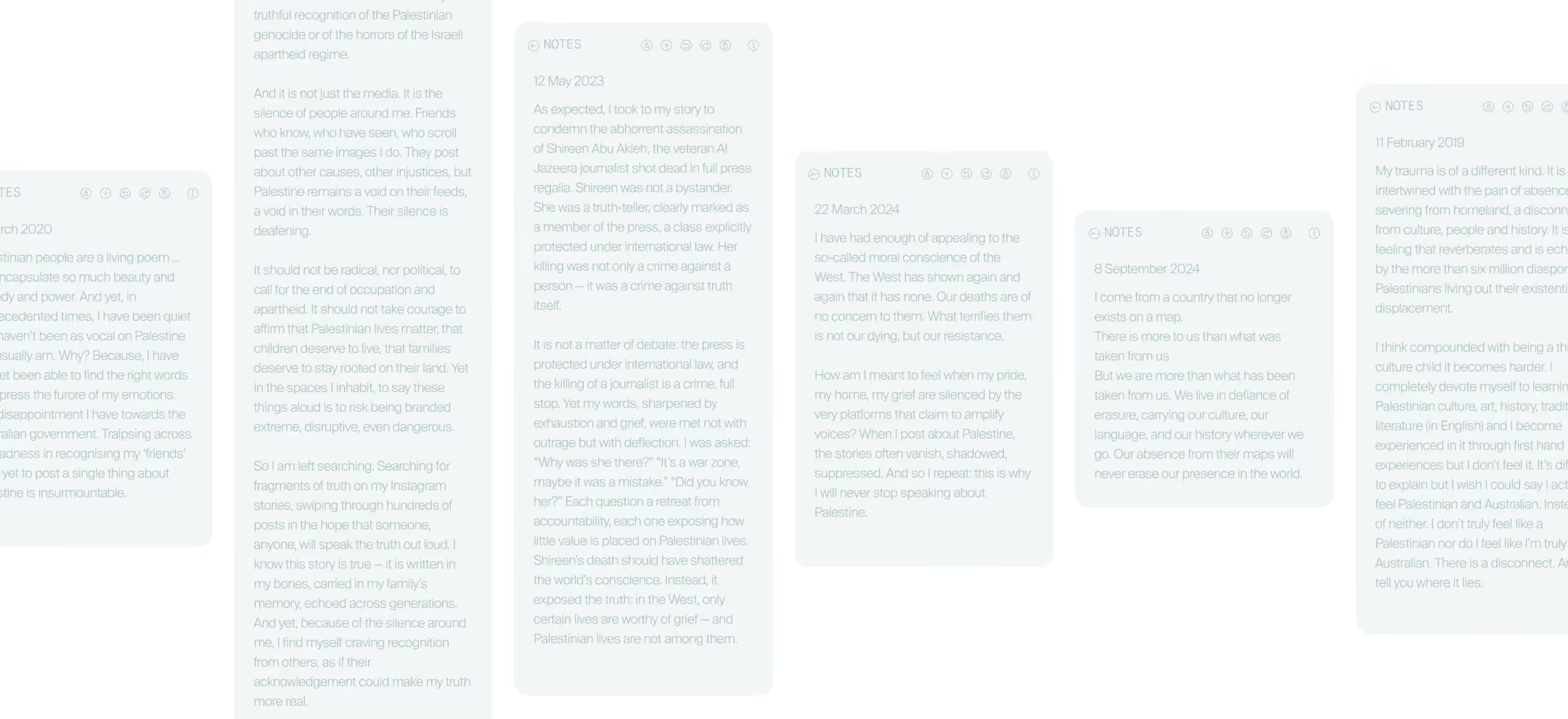
In the notes app on my phone, a space most reserved for shopping lists, recipes, or fragments of thought, I built my own archive. In them lies the story of diasporic Palestine.
Personal Narrative
15 min read
A label that reads 'Enter article'

"Though our bodies may be displaced, our pens and pixels reach back across oceans, anchoring us to the land and culture that remain at the centre of who we are."

WHAT COMES NEXT?
WHAT COMES NEXT?
WHAT COMES NEXT?
WHAT COMES NEXT?
WHAT COMES NEXT?
WHAT COMES NEXT?
WHAT COMES NEXT?
WHAT COMES NEXT?
WHAT COMES NEXT?
WHAT COMES NEXT?

By reading this issue of Rally Magazine, we hope you have felt a deepening of your understanding for the lives of others and an expanding of your empathy. Please don’t stop here.

Read Watch Listen

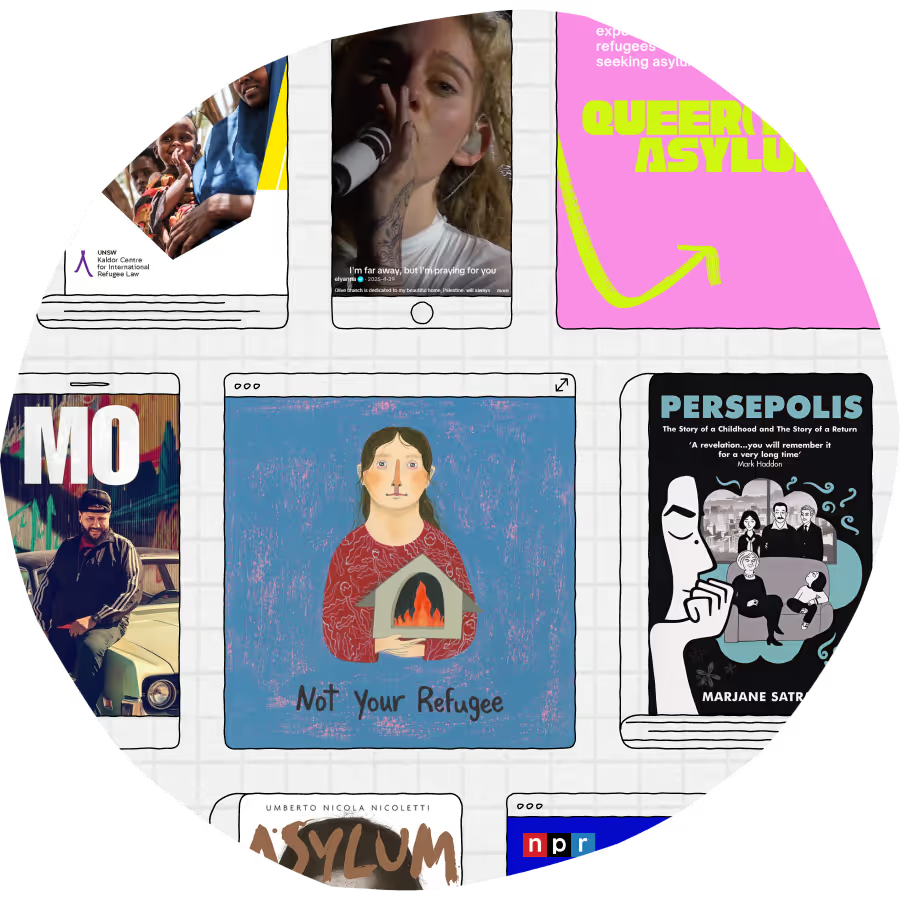
There are many resources that helped inform the creation of this issue which we encourage you to read, watch and listen to.
database
5 Min read
A label that reads 'Enter article'
Purple circle with the words 'Take Action: Support Forcibly Displaced People Network

Act

Our mission at Rally has always been to not only tell stories, but to use storytelling to shift power back towards those on the sidelines.
feature
5 Min read
A label that reads 'Enter article'
THANKS FOR ENJOYING THE DIGITAL ISSUE
Hand drawn pencil scribbling some unidentifiable script
Buy Issue 02: Forging home
Buy Issue 01 Now

Explore Rally
in print

Explore the issue in print

As a multimedia mag, this issue is also available in print. We are a small team of self-funded creatives working hard to make Rally accessible and sustainable. Help support us by ordering a copy.
Shop Now button