


Exit Article button
A label that reads 'Forging home, the migration issue'
Issue 02
Issue 02
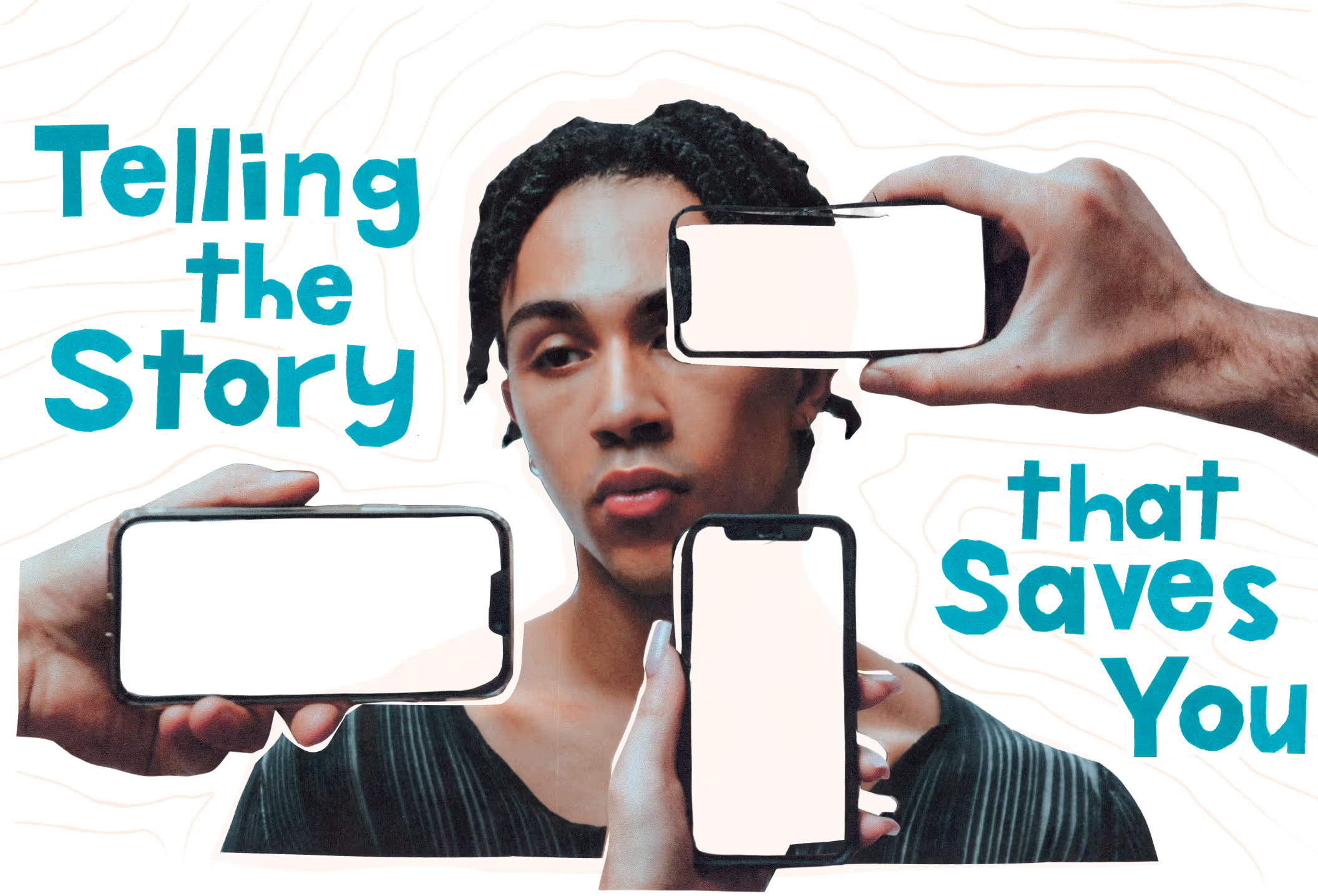
A collage style heading banner with the words 'Telling the story that saves you'

Storytelling is something we all do. But when storytelling becomes a matter of survival, how does this change us as people? How can we create safer spaces for refugees to explore the full humanity of their stories?

By Samah SHDA, Founder of Unbound Stories, images by sejal bhikha
19 MIN READ
Storytelling is something we all do. We share our lives, how we feel, the events that made us angry, excited or inspired with our friends, families and colleagues.

How we tell stories can differ based on the listener. We decide how much worry to pass on. We smooth rough edges in conversations that don’t feel safe. We give partial truths when the full ones feel too heavy to carry alone. We revise the truth to protect, to persuade, to endure. We shape our experiences into coherent sequences, sometimes to understand ourselves, sometimes to help others understand us.

Whether whispered around kitchen tables or spoken in interview rooms, storytelling is how we locate ourselves in the world.

But for some of us, storytelling is not occasional. It becomes a matter of survival.

Storytelling as compliance

I remember sitting in a UN refugee agency office in Turkey after I fled Iraq with my family. Before our resettlement interview, I had memorised my timeline, names, dates and affiliations. I rehearsed my story until it became second nature. There were rules to this kind of storytelling. No inconsistencies. No ambiguity. No unruly emotion. You had to name the groups that targeted you. You had to get every date right.

The story had to be exact, not raw.

This was my first lesson in cultural safety, or the lack of it. The system did not ask whether the story was safe to tell, only whether it was acceptable to hear.

At the time, I did not think of this as storytelling. It felt like learning the rules of the world. In legal and settlement settings, stories must fit the worldview of the officer across the table and the politics of the system they represent. Cultural differences in how stories are told are rarely accommodated. Memory has to be linear. Emotion has to be contained. Anything that does not fit the framework is dismissed as unreliable.

So you adapt.

You flatten nuance. You condense pain. You learn which parts of yourself make the story credible and which parts make it risky. You shape your experiences into something legible.

I did this again years later when I told people that I had returned to Iraq after finishing my Bachelor’s in the United States. I told them the reason I returned was to work in the humanitarian sector. That version of the story was incomplete. What I omitted was that my family had insisted I return. I was scared. ISIS had control over large swathes of Iraq at the time and I wanted to stay in the US to pursue my education. Returning was not a brave choice, but a pressured one.

At the time, I thought no one wanted to hear that version. So I shaped the story into something more acceptable: conviction instead of fear, agency instead of obligation.

This kind of storytelling is not passive. It requires emotional labour and constant calculation. Over time, it teaches you something quietly damaging: that only certain versions of you are acceptable.

The tension between the official story and the lived story does not disappear once the resettlement interview ends. It leaves an imprint. It shapes how you understand yourself, not just how others see you.

"the system did not ask

whether the story

was safe to

tell,

only whether

it was

acceptable to hear."

Storytelling after the system is done with you

Years later, after visas were granted and files were closed, I realised something else. Once the system is done with you, your story changes.

You are no longer telling your story to be believed. You are telling it to live with it.

This is the kind of storytelling that happens at home, not across desks. The kind that tells your children who you are. That lets your community know where you’ve come from. That asks, often quietly, what now?

This realisation shaped the work I would later build.

Working with others who have been displaced, I noticed how often people felt alienated from their own histories. Silence was misread as shame or disengagement. I used to think that too. That people who refused to share their stories were part of the problem.

I no longer believe that.

Silence can be resistance. A refusal to turn pain into performance. A way of preserving dignity in a world that often commodifies suffering.

I was reminded of this when I spoke with a council member who came to Australia as a refugee from Lebanon. He had never shared his displacement story with his children. For years, his silence felt protective. He did not want to bring up the pain. But when recent events in Palestine stirred difficult questions, he told them everything.

His silence, once a shield, became a bridge.

At that moment, storytelling was no longer about survival. It was about continuity. About passing on something truthful, without turning it into spectacle.

"Silence can be resistance.

A refusal

to turn

pain into

performance.

A way

of

preserving dignity

in a world that often

commodifies

suffering."

Storytelling as Responsibility

After ISIS displaced families in our neighbourhood in Iraq, I learned another lesson about storytelling – a much harder one.

Trying to help, I had raised a few thousand dollars for a nearby refugee camp. To report to donors, I interviewed a young Yazidi mother on her conditions to better understand her needs and justify the financial support. She told me her story. She talked about recovering from illness, facing violence and threat in her town, being displaced and uncertain about her future. She generously shared her story. I listened calmly and saw her generosity as a sign of resilience. Her story was difficult to sit with, but I thought that this is what I needed to do to determine if she needs help.  

I gave her $300 in an envelope and left.

Days later, her husband came to my father’s shop, complaining she had been having nightmares since our conversation. Telling me her story had led her to relive her traumatic memories, it sent her back to a depressed state and she did not have the appropriate psychological support within her camp. She couldn’t sleep well after our conversation. I was devastated. I had exchanged money for a story and caused harm. Ashamed of this impact and my naive approach, I never returned to the camp. Instead, I worked through local vendors to distribute aid anonymously.

But that woman stayed with me.

That moment taught me that storytelling without care is not neutral. Compassionate storytelling is not about intention. It is about impact. Since that experience. I learned to reflect on how we ask for stories safely and how we hold them. This is where storytelling becomes a responsibility. It asks not only what is being shared, but how, and at what cost.

"...storytelling without care is not neutral.

Compassionate storytelling is not about intention.

It is about impact."

Storytelling as collective design

I built Unbound Stories, a social impact initiative that grew out of this question: What would it look like to design systems that do not require people to flatten themselves in order to be heard?

Over the years, I have worked with hundreds of storytellers and a wide range of organisations, supporting them to build more inclusive systems for migrants and refugees. Across this work, three ideas kept coming up.

1. Cultural safety

Stories are shaped by power. If conditions are not safe, people adapt their stories to survive.

I learned this twice. Once in the UN office and once in the refugee camp.
Today, when I work with organisations, cultural safety is not a slogan. It is operational.

It means:
  • Establishing advisory groups with lived experience that influence decisions, not just campaigns.
  • Designing consent processes that clarify how stories will be used before they are shared.
  • Training staff to recognise tokenisation and shift from “representation’” to shared authority.
Instead of asking: Who can tell their story for this event? I ask: Who is shaping the system behind the event?

If storytelling does not shift power, it is performance.

2. Compassionate storytelling

Stories are not neutral. How they are asked for, framed and distributed shapes culture.

Whether you work in HR or communications, compassionate storytelling is not peripheral to your role, it sits at the centre of how culture is built.

In practice, this means:
  • Auditing recruitment campaigns and staff profiles to check whether people are framed as contributors or case studies.
  • Rewriting diversity language that centres struggle over skill.
  • Training leadership teams to question what assumptions sit beneath their messaging.
In workshops, I ask teams to review their own materials and identify where nuance has been flattened for convenience. Often, what seems like positive storytelling still reinforces stereotypes.

Compassionate storytelling is not about being gentle. It is about being precise – and willing to sit with discomfort long enough to tell the truth responsibly.

3. Story shaping

Not all experiences are linear. Not all truths arrive in words.

The systems I encountered demanded timelines, clarity, coherence. But trauma, migration, and identity rarely unfold neatly. When we insist on one language and one format, we force people to compress themselves.

So I changed the method.

Instead of structured interviews, I use visual mapping exercises. Participants draw their journeys, relationships, tensions and turning points before speaking about them – or sometimes instead of speaking at all.

This approach:
  • Reduces pressure to perform pain on demand.
  • Allows complexity without forcing a single narrative arc.
  • Engages across languages and literacy levels.
  • Lowers the risk of retraumatisation.
In a recent project with young people from multicultural backgrounds, we used visual mapping to explore identity and leadership. What emerged were not rehearsed trauma stories, but insights about belonging, aspiration and agency. The shift was immediate. Participants moved from telling their story to analysing systems around them.

When the shape of storytelling changes, what organisations learn changes.

If you want different outcomes, you must change the format, not just the message.
Cultural safety, compassionate storytelling and attention to the shape of stories are not abstract ideas. They are design choices. They determine whose voice is heard without distortion, whose knowledge is treated as expertise and whose dignity remains intact.

When we stop extracting stories for credibility and start designing systems that can hold complexity, something shifts. Problems are understood differently. Decisions are made differently. Power moves.

Storytelling is something we all do. But when we tell stories with care, and build structures that allow people to tell them without flattening themselves, storytelling stops being compliance.

It becomes authorship.

And that changes everything.
Unbound Stories logo
Unbound Stories is a pioneering social impact startup dedicated to transforming inclusion, diversity, and equity in professional settings through innovative storytelling.

Book a free consultation at unboundstories.org
Samah Shda
Samah Shda is the founder and CEO of Unbound Stories, a social impact startup established in 2023. The company focuses on promoting inclusion, diversity, and equity in professional settings through storytelling. Unbound Stories provides services like strategic brand storytelling and communications for social impact, aiming to support non-profits, socially responsible businesses, and advocacy groups.

Samah’s motivation for starting Unbound Stories comes from her background in refugee advocacy and community development. Having had the first hand experience of being displaced from her home country of Iraq and working across various regions, she has seen how personal stories can foster understanding and drive social change. Through Unbound Stories, she uses these experiences to encourage inclusive practices within organisations.