


Editorial Letter
Editorial Letter
by Samah Shda, Guest Editor
by Samah Shda, Guest Editor

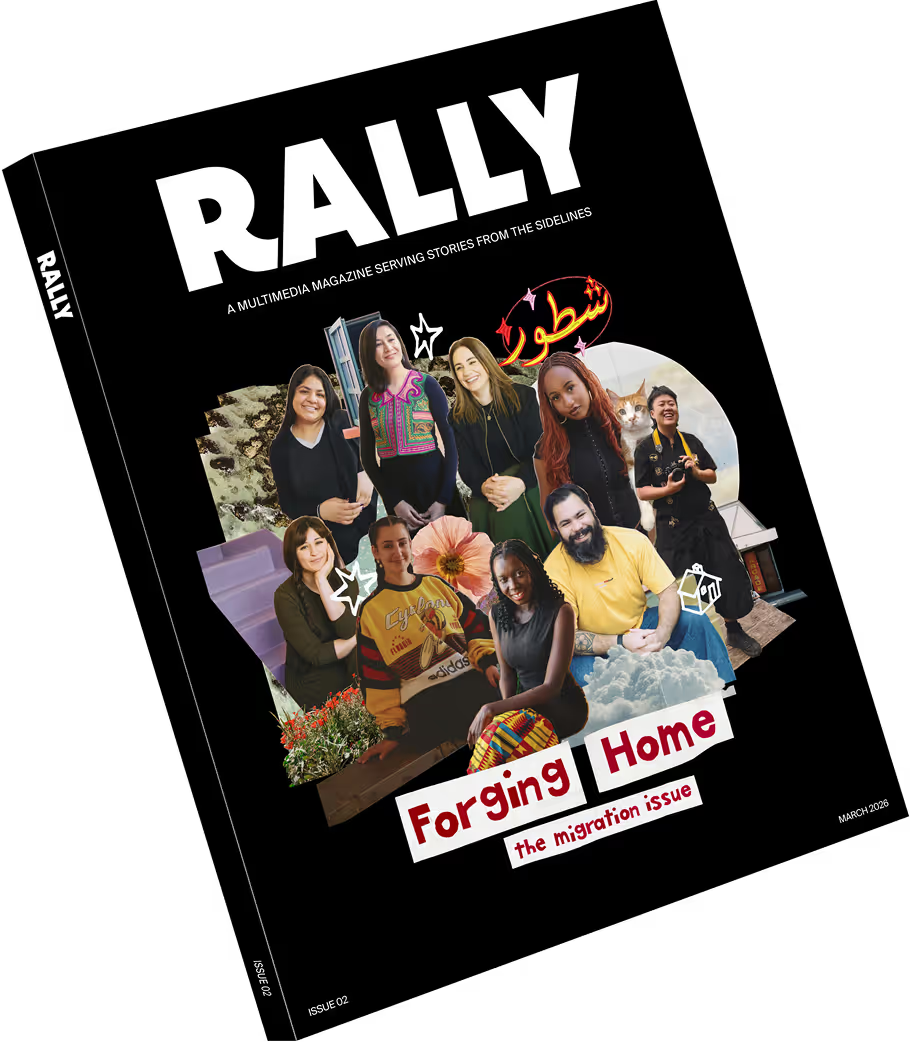
Issue 02: forging home – the migration issue
6 MIN READ
I have spent most of my life being asked to explain myself.
Why I left.
What I survived.
How grateful I am.
How far I’ve come.
Sometimes these questions are asked with care. Often they are asked with urgency, as if my humanity needs to be proven quickly, efficiently, and in a way that reassures the listener. Over time, I learned the shape of the story that was expected of me. I learned where to compress pain, where to insert resilience, and where to land the narrative so it could be received.
I also learned what parts of myself were never invited in.
When storytelling is always oriented outward, toward funders, policymakers, media cycles, or “awareness”, it quietly trains migrants to fragment ourselves. To lead with what is legible. To trade complexity for access. The result is not just personal exhaustion. It is narrative harm.
We become known through repetition: the refugee journey, the success story, the resilience arc. These stories are not false, but they are incomplete. And when incomplete stories circulate long enough, they become the architecture of public imagination. They shape who is believed, who is trusted, who is worthy of safety, and whose grief can be postponed indefinitely.
This issue of Rally began with a refusal, not to tell migrant stories, but to stop telling them in ways that cost the storyteller more than the audience ever has to pay.
In the months leading up to this issue, that refusal took shape in practice. Through my work with the Rally team, drawing on the cultural safety and narrative agency approaches I’ve developed through Unbound Stories, we slowed the editorial process down. We asked not only what stories we wanted to publish, but what conditions were needed for people to tell them without self-erasure.
So we asked a different set of questions.
What does home mean when it is never singular?
What does belonging look like when it is built across borders, languages, and losses?
What parts of yourself are you still protecting from being consumed by explanation?
This issue is not about movement alone. It is about what migrants carry, what we refuse to abandon, and what we are still building, even while navigating systems that would prefer us flattened, grateful, and useful. Home, as you’ll see in these pages, is not a destination. It is an ongoing practice of memory, resistance, care, and imagination.
Storytelling, we insist, is not neutral. It is a site of power. And power demands responsibility.
Our call to action is simple, but not easy.
Treat migration not as a problem to be managed, nor a contribution to be extracted, but as a matter of human rights and human dignity. The first step is not better messaging. It is better listening. Not asking what migrants can do for your nation, but making space for our full humanity, even when it unsettles the story you are used to hearing.
If this issue leaves you with discomfort, curiosity, or a sense that something familiar has shifted, stay with that. That is where change begins.
Why I left.
What I survived.
How grateful I am.
How far I’ve come.
Sometimes these questions are asked with care. Often they are asked with urgency, as if my humanity needs to be proven quickly, efficiently, and in a way that reassures the listener. Over time, I learned the shape of the story that was expected of me. I learned where to compress pain, where to insert resilience, and where to land the narrative so it could be received.
I also learned what parts of myself were never invited in.
When storytelling is always oriented outward, toward funders, policymakers, media cycles, or “awareness”, it quietly trains migrants to fragment ourselves. To lead with what is legible. To trade complexity for access. The result is not just personal exhaustion. It is narrative harm.
We become known through repetition: the refugee journey, the success story, the resilience arc. These stories are not false, but they are incomplete. And when incomplete stories circulate long enough, they become the architecture of public imagination. They shape who is believed, who is trusted, who is worthy of safety, and whose grief can be postponed indefinitely.
This issue of Rally began with a refusal, not to tell migrant stories, but to stop telling them in ways that cost the storyteller more than the audience ever has to pay.
In the months leading up to this issue, that refusal took shape in practice. Through my work with the Rally team, drawing on the cultural safety and narrative agency approaches I’ve developed through Unbound Stories, we slowed the editorial process down. We asked not only what stories we wanted to publish, but what conditions were needed for people to tell them without self-erasure.
So we asked a different set of questions.
What does home mean when it is never singular?
What does belonging look like when it is built across borders, languages, and losses?
What parts of yourself are you still protecting from being consumed by explanation?
This issue is not about movement alone. It is about what migrants carry, what we refuse to abandon, and what we are still building, even while navigating systems that would prefer us flattened, grateful, and useful. Home, as you’ll see in these pages, is not a destination. It is an ongoing practice of memory, resistance, care, and imagination.
Storytelling, we insist, is not neutral. It is a site of power. And power demands responsibility.
Our call to action is simple, but not easy.
Treat migration not as a problem to be managed, nor a contribution to be extracted, but as a matter of human rights and human dignity. The first step is not better messaging. It is better listening. Not asking what migrants can do for your nation, but making space for our full humanity, even when it unsettles the story you are used to hearing.
If this issue leaves you with discomfort, curiosity, or a sense that something familiar has shifted, stay with that. That is where change begins.

Samah Shda
Samah Shda is the founder and CEO of Unbound Stories, a social impact startup established in 2023. The company focuses on promoting inclusion, diversity, and equity in professional settings through storytelling. Unbound Stories provides services like strategic brand storytelling and communications for social impact, aiming to support non-profits, socially responsible businesses, and advocacy groups.
Samah’s motivation for starting Unbound Stories comes from her background in refugee advocacy and community development. Having had the first hand experience of being displaced from her home country of Iraq and working across various regions, she has seen how personal stories can foster understanding and drive social change. Through Unbound Stories, she uses these experiences to encourage inclusive practices within organisations.
Samah’s motivation for starting Unbound Stories comes from her background in refugee advocacy and community development. Having had the first hand experience of being displaced from her home country of Iraq and working across various regions, she has seen how personal stories can foster understanding and drive social change. Through Unbound Stories, she uses these experiences to encourage inclusive practices within organisations.